JioPhone 2 coupled with Monsoon Hungama offer with Reliance Jio fourth-generation (4G) services, would not only ruin their businesses but also defeat the Make in India purpose.

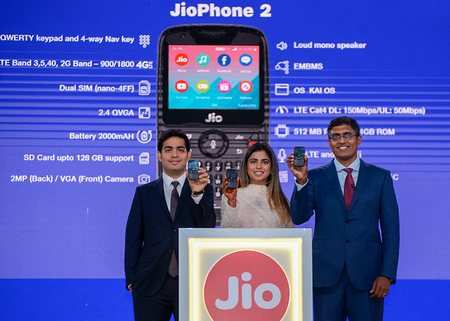
Mukesh Ambani's son and daughter Akash and Isha Ambani launch JioPhone 2 during the company's Annual General Meeting (AGM), in Mumbai on Thursday, July 05, 2018.Photo) Indian billionnaire Mukesh Ambani has recently announced the launch of JioPhone 2 and set out an ambitious target to achieve 100 million shipments that has rattled the local feature phone makers. Local firms already sitting on huge inventories fear that the JioPhone 2 coupled with Monsoon Hungamaoffer with Reliance Jio fourth-generation (4G) services, would not only ruin their businesses but also defeat the Make in India purpose. Bhupesh Raseen, Mobile Advisory Committee Chairman of The Mobile Association that claims to represent nearly 200 firms including handset makers such as Karbonn, Lava and Itel speaks to ETTelecom’s Muntazir Abbas on the pressing issue. Edited excerpts.
How JioPhone 2 is going to disrupt the market since a Rs 501 is for an exchange of old JioPhone only?
TMA: As per our understanding gathered from various market sources, the JioPhone2 is going to be available in exchange for any old phone. For example, normal retail prices for 4G feature phones offered by various brands such as Micromax and Lava range from Rs. 2,100 for the Micromax Bharat 1 4G model, to Rs. 3,333 for the LAVA 4G Connect M1 model. If Reliance Jio is permitted to offer a similar phone at the much lower price point of Rs 501 per unit, the businesses of genuine mobile vendors like Intex, Itel, Jivi Mobiles, Karbonn, Lava, Micromax and nearly 100 other brands will be rendered uncompetitive and unviable overnight. This may force the Indian brands, who rely for a bulk of their revenues on sales of feature phones, to shut down their manufacturing and sales operations completely.
As per industry/TMA analysis, how many JioPhones have shipped so far and how much market share it commands today?
TMA: As per Counterpoint Research, the market share of Jio in overall shipments of feature phones was recorded at 26% in terms of units in Q4 of CY 2017, while for the entire calendar year 2017, it was estimated to be 11%.
Do you think JioPhone devices are not produced in India?
TMA: JioPhone devices are not Made in India. As per our understanding JioPhone devices are all imported from China. The telecom service provider is now planning to import large volumes via Indonesia to enjoy 0% customs duty.
How many domestic players are going to impact?
TMA: At least 100 players assembling or making mobile phones will be negatively impacted if the telecom service provider is allowed to lease (sell) JioPhone 2 4G feature phones at Rs 501 per unit. Intex, Itel, Jivi Mobiles, Karbonn, Lava and Micromax are some of the leading brands that will be impacted.
Will such an offering impact multinationals like Samsung, Oppo, Vivo and Gionee etc?
TMA: Multinational vendors like Apple and Samsung and Chinese vendors like Oppo, Vivo and Xiaomi will not be impacted too much as per our estimates because the bulk of their shipments and revenues accrue from sales of smartphone devices.
How much investment has gone into local manufacturing (Make in India) by domestic players?
TMA: As per Counterpoint Research, $ 653 million was invested up to 2016 by as many as 125 local manufacturers. This number has only gone up in 2017 and 2018.

Mukesh Ambani's son and daughter Akash and Isha Ambani launch JioPhone 2 during the company's Annual General Meeting (AGM), in Mumbai on Thursday, July 05, 2018.Photo) Indian billionnaire Mukesh Ambani has recently announced the launch of JioPhone 2 and set out an ambitious target to achieve 100 million shipments that has rattled the local feature phone makers. Local firms already sitting on huge inventories fear that the JioPhone 2 coupled with Monsoon Hungamaoffer with Reliance Jio fourth-generation (4G) services, would not only ruin their businesses but also defeat the Make in India purpose. Bhupesh Raseen, Mobile Advisory Committee Chairman of The Mobile Association that claims to represent nearly 200 firms including handset makers such as Karbonn, Lava and Itel speaks to ETTelecom’s Muntazir Abbas on the pressing issue. Edited excerpts.
How JioPhone 2 is going to disrupt the market since a Rs 501 is for an exchange of old JioPhone only?
TMA: As per our understanding gathered from various market sources, the JioPhone2 is going to be available in exchange for any old phone. For example, normal retail prices for 4G feature phones offered by various brands such as Micromax and Lava range from Rs. 2,100 for the Micromax Bharat 1 4G model, to Rs. 3,333 for the LAVA 4G Connect M1 model. If Reliance Jio is permitted to offer a similar phone at the much lower price point of Rs 501 per unit, the businesses of genuine mobile vendors like Intex, Itel, Jivi Mobiles, Karbonn, Lava, Micromax and nearly 100 other brands will be rendered uncompetitive and unviable overnight. This may force the Indian brands, who rely for a bulk of their revenues on sales of feature phones, to shut down their manufacturing and sales operations completely.
As per industry/TMA analysis, how many JioPhones have shipped so far and how much market share it commands today?
TMA: As per Counterpoint Research, the market share of Jio in overall shipments of feature phones was recorded at 26% in terms of units in Q4 of CY 2017, while for the entire calendar year 2017, it was estimated to be 11%.
Do you think JioPhone devices are not produced in India?
TMA: JioPhone devices are not Made in India. As per our understanding JioPhone devices are all imported from China. The telecom service provider is now planning to import large volumes via Indonesia to enjoy 0% customs duty.
How many domestic players are going to impact?
TMA: At least 100 players assembling or making mobile phones will be negatively impacted if the telecom service provider is allowed to lease (sell) JioPhone 2 4G feature phones at Rs 501 per unit. Intex, Itel, Jivi Mobiles, Karbonn, Lava and Micromax are some of the leading brands that will be impacted.
Will such an offering impact multinationals like Samsung, Oppo, Vivo and Gionee etc?
TMA: Multinational vendors like Apple and Samsung and Chinese vendors like Oppo, Vivo and Xiaomi will not be impacted too much as per our estimates because the bulk of their shipments and revenues accrue from sales of smartphone devices.
How much investment has gone into local manufacturing (Make in India) by domestic players?
TMA: As per Counterpoint Research, $ 653 million was invested up to 2016 by as many as 125 local manufacturers. This number has only gone up in 2017 and 2018.
Comments
Post a Comment
Please give some suggestions or share your experience here...